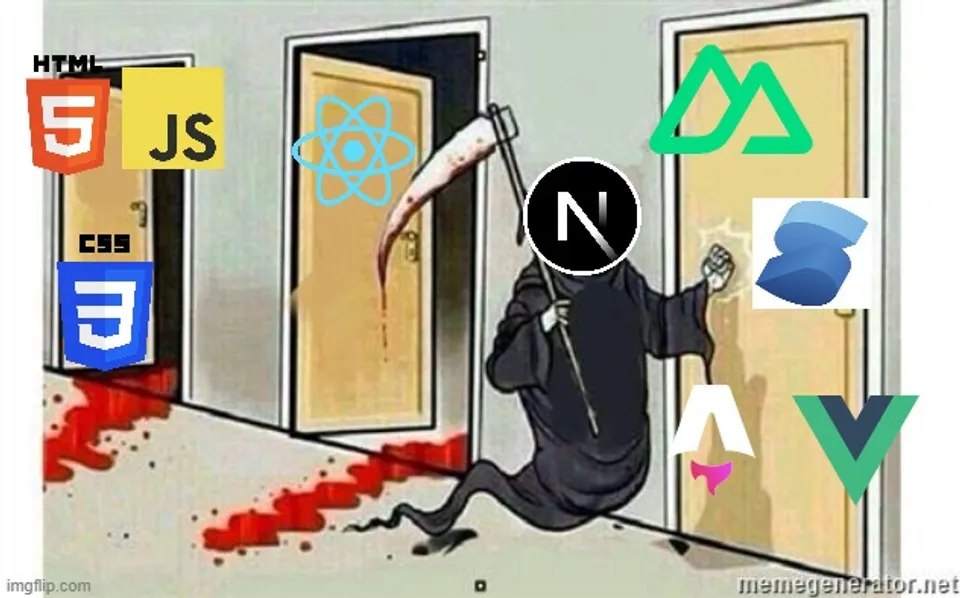
Why NextJS keeps winning
I miss the time…
I miss the time when JS fatigue was still a thing — when frontend development ecosystems felt heavy and promise‑laden but chaotic. When no omnipresent AI “overlord” told me that every dev might become obsolete soon. Yet despite all the hype, uncertainty, and rapid shifts, one thing remains true: NextJS keeps becoming the de facto standard. Every new SaaS product I see seems to use it — and so do many of the latest startups. And when I ask: why though? — there are many good answers.
Where it all began
Next.js was created by Vercel (originally “ZEIT”) and first released in 2016. From the very start, it was meant to make React applications easier to build, but with production‑readiness: server‑side rendering (SSR), static site generation (SSG), zero‑config setup, and simple deployment.
Next.js quickly gained traction because it took away the boilerplate: no need to manually wire up SSR or routing or build config from scratch — you could get started fast, but still ship robust apps.
Why Next.js kept growing — core strengths
Over time, Next.js outgrew its “quick SSR wrapper” label. Here’s why many teams embraced it:
- Hybrid rendering: SSR, SSG, and more. Next.js supports server‑side rendering (SSR), static site generation (SSG), and incremental/static regeneration — letting you pick the right strategy per page.
- Automatic code‑splitting & built‑in optimizations. It automatically splits code so that users only download what’s needed — improving load times.
- Routing & file‑based structure out of the box. No need to configure complex routers — pages and APIs map to folders/files.
- Good developer experience and fast iteration. Hot reload, well‑documented conventions, and ease of setup (zero‑config, quick
create-next-app) helped lower the barrier for beginners and small teams. - Performance + SEO friendly defaults. SSR + SSG combined with optimizations (image optimizations, code splitting, caching, etc.) made Next.js-powered sites often fast, performant, and SEO‑ready.
Thanks to that mix — flexibility, performance, simplicity — Next.js became appealing both for small startup-style projects and large-scale enterprise apps.
Next.js 16 — The latest leap forward
The just-released Next.js 16 raises the bar even further, with updates that address modern expectations around performance, caching, developer experience, and architecture.
What’s new
- Turbopack as default bundler — replaces Webpack in new projects, bringing up to 10× faster fast-refresh and 2–5× faster production builds out of the box.
- New “Cache Components” model + explicit caching APIs — with a
"use cache"directive, plus helpers likerevalidateTag()/updateTag(). This gives developers fine‑grained control over caching — especially useful for dynamic apps. - Better routing & navigation performance — layout‑deduplication, smarter prefetching, and improved navigation behavior: when you prefetch many links with the same layout, the layout downloads only once.
- New DevTools & improved logging/debugging — the integrated tooling gives clearer insight into your build, rendering, routing, and caching behavior.
- Simplified modern deployment/resilience options — Next.js 16 introduces a “Build Adapters API,” making it easier to deploy to edge environments or non‑Vercel infrastructures.
What this means for real-world apps
With 16, Next.js becomes even better suited for big, complex, dynamic web applications — not just static sites or simple marketing pages. You get fast dev loops, high performance, predictable caching and rendering behavior, and flexibility in deployment strategy.
For SaaS dashboards, e‑commerce platforms, high‑traffic content sites, or global apps — Next.js 16 hits a sweet spot.
Trade-offs
Of course, nothing’s perfect. Compared to a plain SPA or a highly optimized bespoke stack, Next.js does add abstractions. There are trade-offs in complexity, build setup, and for some use-cases — especially very real-time or extremely dynamic apps — it may not always be the optimal choice.
Some in the community argue that for extremely custom backend or microservice-heavy systems, coupling frontend and backend logic in a “framework + full-stack” can blur concerns.
The most biggest concern is that there is a huge vendor lock-in risk: Next.js is developed by Vercel, and while it’s open-source, many features are tightly integrated with Vercel’s platform. This can make switching hosting providers or architectures more challenging down the line and many times you will have to develop your own custom solutions.
But for many mainstream use-cases — SaaS, content platforms, e-commerce, documentation sites — Next.js still strikes the best balance between developer happiness and production-ready performance.
Why Next.js keeps winning (and probably will keep winning)
- Combines the best of React (component model, ecosystem) with production-ready features (SSR, SSG, routing, code-splitting).
- Scales with your needs: from a quick prototype to a full SaaS or enterprise app — you don’t need to rewrite when you grow.
- Strong community and backing (by Vercel): continuous improvements, new features, and a stable ecosystem.
- Version 16: performance, caching, routing, deployment surfaced even more clearly. Developers get immediate wins.
- Reduces “time to market” while delivering SEO + performance + flexibility — critical for SaaS and web apps.
What’s next for Next.js in 2026 and beyond
More fine-tuned performance, caching & rendering
- Turbopack will continue to improve build and refresh speeds.
- “Cache Components” and
"use cache"directives will likely evolve with smarter cache invalidation strategies for dynamic content.
Tooling, developer experience & deployment flexibility
- Expect improved DevTools, better debugging/logging, and potential AI-assisted insights for performance issues.
- Build Adapters API will likely expand, enabling easier deployment across diverse infrastructures (edge, serverless, custom).
Closer alignment with modern React + web platform evolutions
- Next.js will integrate new React features (streaming SSR, Server Components improvements, concurrency) for faster, more efficient apps.
- Hybrid rendering models may become more robust, mixing static, server-rendered, client-hydrated, and partially hydrating components.
Better customization & real-world complexity support
- More flexible plugin system, advanced middleware, improved SSR/CSR hybrid tools, better TypeScript support.
- Focus on scalability and maintainability for large codebases, monorepos, and complex SaaS applications.
Community, ecosystem & adoption
- Growing ecosystem of starter kits, templates, and integrations.
- Enhanced support for common patterns (auth, state management, CI/CD) to reduce boilerplate.
- Ongoing discussion on edge-cases like real-time apps, plugin support, and monorepos will shape development priorities.
Challenges to watch
- Balancing abstraction vs control as features expand.
- Maintaining stability and compatibility with custom plugins or complex deployments.
- Optimizing predictability for caching, rendering, and partial hydration in complex apps.
Conclusion
Even as the web ecosystem becomes more crowded — with new frameworks, new tools, and even AI-generated code — Next.js manages to stay ahead. It doesn’t promise magic, but it offers practical, powerful, and predictable tools that match the needs of modern web development: from fast iteration to global scale.
That’s why, despite all the noise, Next.js keeps winning.